
Extended Producer Responsibility Laws Expand Across States; Key Compliance Deadlines Approaching
Key Takeaways
- Packaging extended producer responsibility laws are now in effect in seven states, with additional states advancing similar frameworks. These laws shift responsibility for packaging waste management from municipalities to companies placing materials into the market.
- These laws create state-specific compliance obligations, including PRO participation, reporting and fee payments. Noncompliance can trigger enforcement referrals and significant penalties as deadlines take effect between 2025 and 2030.
- Companies should assess whether they qualify as obligated producers and identify applicable state requirements, and focus on upcoming registration and reporting deadlines, including upcoming deadlines on May 31, 2026.
Extended Producer Responsibility (EPR) laws are expanding rapidly across the United States. These laws shift the financial responsibility for collecting, recycling and managing packaging waste from consumers and municipalities to the companies that place these materials into the marketplace. Seven states — California, Colorado, Maine, Maryland, Minnesota, Oregon and Washington — have enacted packaging EPR laws, while Hawaii and Massachusetts are studying similar frameworks and other states are considering legislation.
Although packaging EPR laws generally follow the same framework, the details vary by state. For example, states differ in the materials covered, the entities that qualify as the obligated “producer,” the exemptions available and the timing of compliance obligations. In most states, “covered materials” include some combination of packaging, paper products and food serviceware, with exemptions for products such as infant formula, medical devices and certain agricultural products. Producer responsibility typically rests first with the brand owner and, in some cases, may shift to the manufacturer, licensee, importer or distributor. Some states, including Maryland and Minnesota, also apply different rules to e-commerce sales than to traditional retail sales. This alert provides a general overview of producer obligations, key compliance deadlines and expected legislative developments. For specific guidance on determining applicability and complying with EPR laws, please reach out to a member of the Polsinelli Environmental Practice Group.
What Producers Need to Know
Companies that qualify as producers under state packaging EPR laws may be required to participate in an approved Producer Responsibility Organization (PRO) or Stewardship Organization (SO) rather than operate an individual compliance program. In practice, that means identifying covered materials sold in or into each state, determining whether the company is the legally responsible producer, reporting required data and paying program fees. Those fees are generally used to support recycling system improvements, education, administration and other program costs. At this time, Circular Action Alliance (CAA) has been approved as the PRO in California, Colorado, Minnesota, Maryland, Oregon and Washington, and Maine expects to select its SO in spring 2026. Maryland’s law contemplates an approved PRO structure as well, but implementation is still developing through the regulatory process.
Implementation timelines vary. Some states have already begun rolling out their programs, while others have key compliance deadlines between 2026 and 2030. These laws also carry enforcement risk. In many states, the PRO may refer noncompliant companies to the relevant agency for enforcement. For that reason, companies should assess now whether they may be obligated in any state and track upcoming deadlines closely.
Key Deadlines
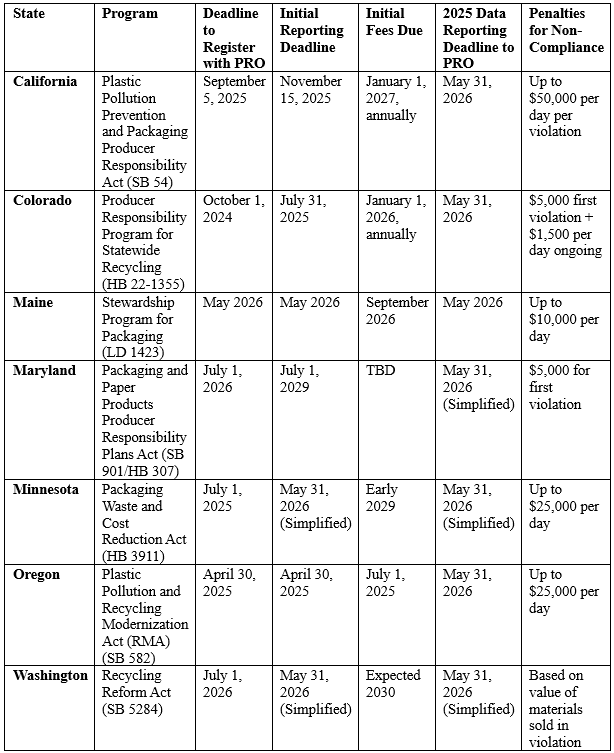
* “Simplified” reporting involves the reporting of broader material categories, rather than what is required through the submittal of full reporting.
States to Watch
Several additional states are laying the groundwork for packaging EPR laws. In May 2025, Hawaii enacted legislation directing the Department of Health to conduct a needs assessment and convene an advisory council to evaluate a potential transition to an EPR framework, with a report due by Dec. 31, 2027. Massachusetts has taken a similar step. In 2024, it established an EPR Commission, which issued a draft final report in December 2025 outlining potential approaches to improve collection convenience, protect small businesses through exclusion thresholds and reduce uncertainty through education and clearer statutory drafting.
Furthermore, legislative debate is ongoing in states including New York, Missouri and Tennessee. In New York, Senate Bill 1460 has been referred to the Senate Environmental Conservation Committee. Likewise, Missouri House Bill 3504 and Tennessee Senate Bill 269 remain active in their respective state legislatures. As EPR legislative debate continues in states around the country, producers of covered materials will need to monitor emerging requirements and proactively adapt their compliance strategies across supply chains.
Practical Takeaways for Producers
For many companies, the most difficult aspect of EPR compliance is determining, on a state-by-state basis, whether the company is the legally obligated producer; which materials are covered; whether an exemption applies; and when compliance deadlines begin. That analysis is especially challenging for companies with complex supply chains, private label products, imported goods, licensing arrangements and significant e-commerce sales. Companies should assess now which states may apply to their operations, confirm who bears producer responsibility for each covered material and identify the next applicable registration, reporting and fee deadlines.
With several deadlines already passed and more coming on May 31, 2026, companies that have not yet evaluated their EPR exposure should consider doing so now. Please contact a member of the Polsinelli Environmental Practice Group for assistance with compliance obligations and deadlines.