California’s Latest Employment Laws: AI, Surveillance and Compliance Changes Employers Should Know
October 09, 2026
On Sept. 30, 2026, Gov. Gavin Newsom signed several new employment laws affecting artificial intelligence, workplace surveillance, pay data reporting, workplace safety and employment agreements. Most take effect Jan. 1, 2027, with important exceptions noted below.
Key Highlights
- AI assisted employment decisions will require greater human oversight. SB 947 limits employers’ reliance on automated systems for discipline and termination, while SB 951 adds disclosure requirements when AI or other automated technology substantially contributes to a covered workforce reduction.
- Workplace surveillance technologies face new restrictions. AB 1331 limits surveillance in workplace bathrooms, and AB 1883 limits AI-enabled tools that collect neural data or infer workers’ emotional states.
- Several existing compliance obligations now carry new requirements or greater consequences. The new laws affect stay or pay agreements, Cal/OSHA investigations, pay data reporting, discrimination protections, workplace violence response and wages for certain agricultural workers.
AI and Automated Employment Decisions
SB 947 Automated Decision Systems
Beginning July 1, 2027, employers may not rely solely on an automated decision system (ADS) to discipline or terminate an employee. If an employer primarily relies on an ADS, a human reviewer must corroborate the recommendation using underlying data or other supporting information. Employers must also provide written notice when an ADS is primarily relied upon and, upon request, information about the employee data used.
Employer takeaway: Employers should identify automated tools used in discipline and termination, establish a meaningful human review process and confirm that third-party vendors can provide the information needed to satisfy the new notice requirements.
SB 951 Technology Displacement and Cal-WARN
SB 951 adds disclosure requirements when AI or other automated technology causes a mass layoff, relocation or termination subject to the California WARN Act. The notice must identify affected positions and locations, the job functions being automated and the technology involved, and must label the action a “technology displacement.”
Employer takeaway: Address potential Cal-WARN obligations early and coordinate among legal, HR and operational teams so required notices accurately explain technology’s role in the workforce reduction.
Workplace Surveillance
AB 1331 Workplace Bathroom Surveillance
AB 1331 expands California’s workplace privacy protections by restricting employers from using workplace surveillance technology, including certain tracking tools, to monitor employees in workplace bathrooms. The law generally allows employees to leave those devices behind before entering a bathroom, subject to limited exceptions.
Employer takeaway: Employers should review monitoring tools to determine whether they continue collecting covered information when employees use workplace bathrooms and adjust policies or settings where necessary.
AB 1883 AI-Enabled Workplace Surveillance
AB 1883 prohibits employers from using AI-enabled surveillance tools to collect employees’ neural data or to determine or predict their emotional state, subject to limited exceptions.
Employer takeaway: Employers should review AI-based monitoring and employee analytics tools to determine whether they analyze employees’ emotions or collect neural data and disable prohibited functions.
Other Employment Law Changes
AB 1697 Stay-or-Pay Agreements
AB 1697 revises California’s recently enacted restrictions on “stay-or-pay” agreements, requiring workers to repay certain employment-related costs when employment ends. Most notably, the law pushes the restrictions back one year, so they now apply to contracts entered into on or after Jan. 1, 2027, with new exceptions for certain recruitment and retention programs, paid time off advances and other specified arrangements.
Employer takeaway: Employers that use repayment provisions for bonuses, training, education or similar benefits should review those agreements before entering into new contracts in 2027 and confirm whether any statutory exception applies.
AB 2321 Cal/OSHA Investigations
AB 2321 expands the potential criminal consequences of serious workplace safety violations and strengthens Cal/OSHA’s investigation process. Previously, a willful safety violation could trigger criminal liability when it caused an employee’s death or permanent or prolonged impairment. AB 2321 now extends that potential liability to violations that cause serious injury, illness or exposure. The law also requires Cal/OSHA’s Bureau of Investigations to investigate certain serious incidents involving a willful violation and makes it a misdemeanor to willfully interfere with specified Cal/OSHA inspection or investigation duties.
Employer takeaway: Employers should revisit serious incident and Cal/OSHA inspection protocols, including escalation to legal and safety personnel.
SB 1237 Pay Data Reporting
SB 1237 significantly increases the consequences of repeatedly failing to file California pay data reports. The maximum civil penalty for a subsequent failure increases from $200 to $1,000 per employee.
Employer takeaway: Covered employers should review their pay data reporting process and ensure reports are complete, accurate and timely filed.
AB 2563 Sex Discrimination
AB 2563 makes California’s sex discrimination protections more explicit under FEHA, including protections involving gender stereotypes, gender identity or expression, pregnancy and related conditions, sexual orientation and variations in sex characteristics. The Legislature states that the law is intended to clarify existing protections rather than create new ones.
Employer takeaway: Employers should review workplace policies and training materials to ensure they clearly reflect the protections expressly identified under FEHA.
AB 1961 Workplace Violence Restraining Orders
AB 1961 expands an existing workplace safety remedy by allowing employers to seek a restraining order when a threat targets a workplace or group of employees, even if no particular employee is singled out.
Employer takeaway: Employers should incorporate this expanded option into workplace violence response procedures for threats directed at a facility or group of employees.
AB 2646 Minimum Wage for Certain Agricultural Workers
AB 2646 establishes a new minimum wage for certain temporary or seasonal agricultural workers and California employees performing the same or substantially similar work for the same employer in the same county. The law sets a base rate of $19.75 per hour, subject to an annual cost-of-living adjustment beginning Jan. 1, 2027.
Employer takeaway: Agricultural employers should identify covered workers and update payroll practices to account for the annual adjustment.
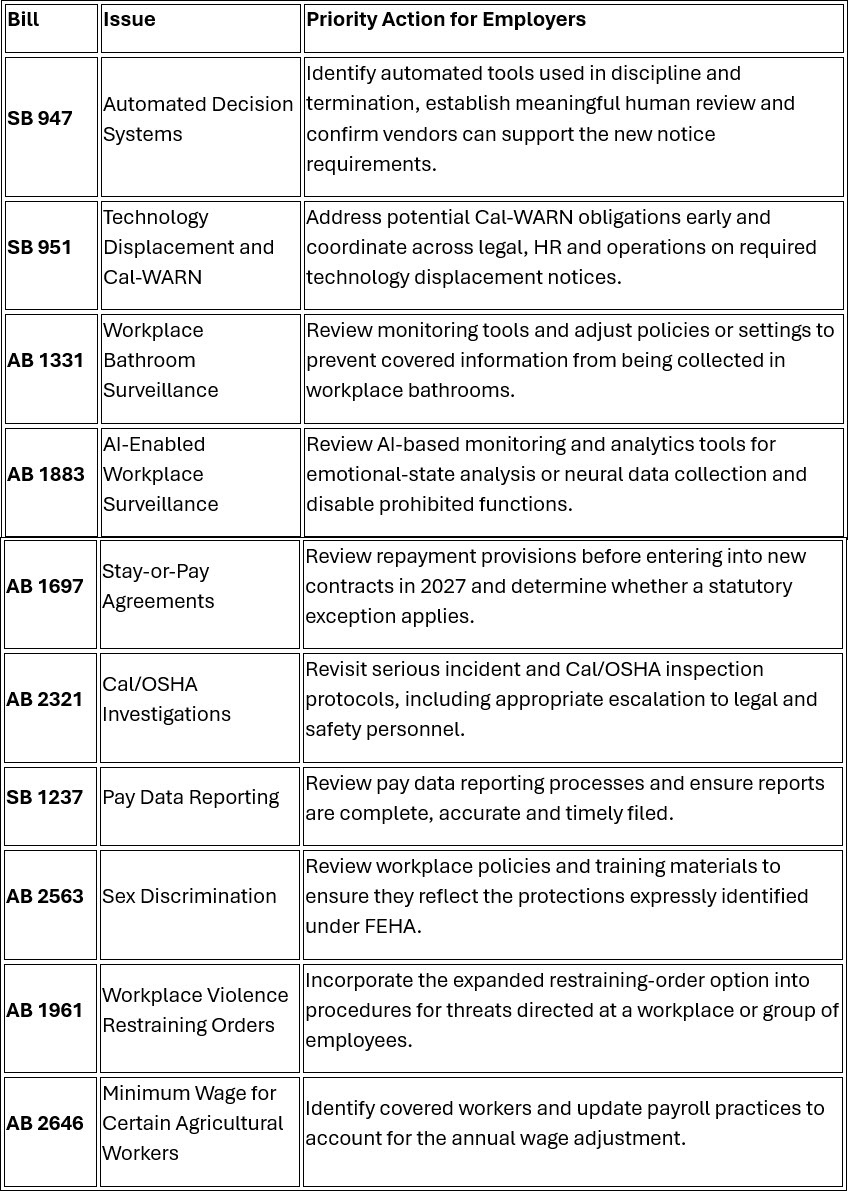
At a Glance: What Employers Should Do Now
Employers should begin reviewing affected policies, technologies, agreements and compliance procedures now to identify any changes needed under these new laws. These laws also reflect California’s continued focus on emerging workplace technologies and expanding employer compliance obligations.
Multistate employers should consider whether these changes may have implications for broader companywide policies, technologies or practices, particularly where they use a uniform approach across jurisdictions. Polsinelli’s Labor and Employment attorneys are available to help assess these changes and prepare for compliance.