Polsinelli’s Energy Law practice has achieved a national presence by representing energy companies, utilities, developers, lenders and investors across the country in connection with the acquisition, development, finance and operation of a variety of energy facilities – including electric generating facilities, wind, solar, geothermal, biomass and biofuel renewable energy projects along with oil and gas.

Our Energy group attorneys have a broad range of interdisciplinary experience and depth of knowledge that allows them to effectively collaborate with clients to achieve their legal objectives. The team also benefits from the valuable perspective of its members who have served previously as in-house counsel and leadership of federal and state regulatory agencies. Our vast experience in real estate, environmental, construction, land use, finance, regulatory, business, tax, construction and litigation issues is an invaluable resource for meeting our clients' unique goals.

Our attorneys commonly partner with clients on matters ranging from structuring a business or organization; ensuring that energy development is compliant with industry standards and government regulations; acquiring, permitting, developing, financing, constructing and operating a facility; and protecting investment in workout and litigation situations.

Our work with energy clients includes:

Renewable Energy Project Development

Recognized as a leader in renewable energy and representing developers, owners, utilities, investors, consumers and lenders with all aspects of the development and transaction process.

Public Utilities & Energy Consumers

Assisting major industrial consumers, as well as regulated and non-regulated utilities, with a broad spectrum of unique legal issues.

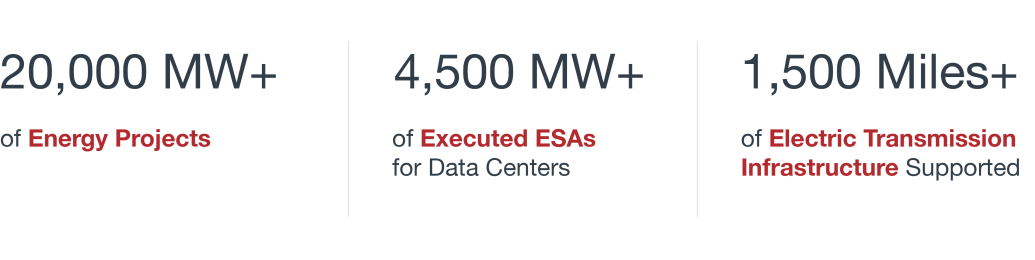
Energy for Data Centers

Representing data center developers and cloud service providers in tariff proceedings, service agreement negotiations and project development.

Electric Transmission and Linear Infrastructure

Handled certificated, obtained siting authority and guided the acquisition of right-of-way for over 1,500 miles of electric transmission lines.

Battery Storage

Supporting developers and investors in battery storage projects with pragmatic guidance across the project lifecycle.

Energy Transactions

Representing energy companies, developers, and major industrial consumers in energy contracting and transactions to facilitate efficient use of energy services and sources, including partnering with energy services companies and host facilities to achieve reductions in load, costs and emissions.

Publications
USDA Proposes Changes to AFIDA Rules and Enforcement - Are You In Compliance?
Key Takeaways: The USDA has proposed changes to AFIDA rules and enforcement, including stricter penalty provisions that would eliminate its discretion to reduce civil penalties for late or missed filings. The proposal reflects increasing federal scrutiny of foreign ownership in U.S. agricultural land, with potential penalty exposure expected to rise as USDA and Congress continue to focus on AFIDA reporting, enforcement and data collection. Foreign-owned agribusinesses, investors and companies should review current and planned U.S. agricultural land interests for potential AFIDA filing obligations, including acquisitions, dispositions, leases and other holdings that may require reporting within 90 days. On June 25, the United States Department of Agriculture (USDA) released a new proposed rule updating the Agricultural Foreign Investment Disclosure Act (AFIDA) and its reporting obligations. Notably,
Read More
Data Centers in the Mid-Atlantic Face a New Legal Frontier: “Bring Your Own Generation”
Key Takeaways Governors from Pennsylvania, New Jersey, Maryland and Virginia have proposed a “Bring Your Own Generation” (BYOG) model to fast-track data center approvals and ease pressure on the grid. The proposal calls for developers to supply their own generation in exchange for accelerated interconnection and facility permitting. While BYOG could meaningfully shorten time-to-power, it cannot function under current law without significant changes to PJM’s tariff, FERC oversight, and state utility and permitting regimes. Data center and generation developers should begin aligning contracts, procurement strategies and regulatory engagement to prepare for this shift. Transitional risk is real, and early movers with flexible deal structures will be best positioned. In a recent eight-page proposal to PJM, the regional grid operator for much of the Mid-Atlantic,
Read More