
Rise in IP Litigation Brings Patent vs. Trade Secret Strategy Back Into Focus
Key Takeaways
- Patent and trade secret protection solve different IP strategy problems, with patents generally fitting inventions likely to be disclosed and trade secrets generally fitting information that can remain confidential.
- Choosing trade secret protection mainly to avoid patent costs can create risk if the information is later revealed, shared too broadly or difficult to prove as protected in litigation.
- Companies should assess each asset’s commercial use, disclosure path, access controls, enforcement posture and patentability before deciding whether to patent, maintain secrecy or use a patent-first strategy with a non-publication request to maintain optionality.
One of the most common strategic questions I hear from clients is whether a new innovation should be patented or kept as a trade secret. In recent years, that question seems to arise more often — and in a broader range of industries. Companies increasingly develop and commercialize technology alongside contract manufacturers, contract research organizations (CROs), contract development and manufacturing organizations (CDMOs), software vendors, cloud providers, investors, joint-development partners and other third parties, expanding the number of people and organizations that may need access to valuable intellectual property. At the same time, patent litigation has rebounded, trade secret litigation continues to rise as the Defend Trade Secrets Act (DTSA) enters its second decade, and businesses are under increasing pressure to spend IP budgets strategically rather than simply patent everything.
Those trends make the patent-versus-trade-secret decision more important than ever. Patent and trade secret protection solve different business problems. A patent is a public bargain: the inventor discloses the invention in exchange for a limited-term right to exclude others from practicing the claimed invention. Trade secret protection works differently. It protects valuable information that derives economic value from not being generally known or readily ascertainable, so long as the owner takes reasonable measures to keep it secret. A trade secret can theoretically last forever — but only if secrecy is maintained.
That distinction matters because companies often view trade secret protection primarily as a way to avoid the upfront cost of patenting. While cost is certainly part of the equation, it is rarely the right starting point. The better question is whether the company can realistically keep the information secret long enough to capture its commercial value, limit access to those who genuinely need it, commercialize the technology without revealing it, detect misappropriation if it occurs, and later prove that reasonable measures were taken to protect it.
In general, patents are strongest when disclosure is inevitable, copying is easy, independent development is a realistic possibility or enforcement against market competitors is important. Trade secrets are strongest when the technology can remain confidential, is difficult or uneconomical to reverse engineer, and access can be tightly controlled through technical safeguards, business processes and contractual obligations.
Patent Cost Should Not Drive the Strategy Alone
The appeal of trade secret protection is obvious. Patent applications are expensive. Preparing, filing and prosecuting a meaningful application can require significant investment before a company knows whether the technology will succeed commercially.
But “cheaper today” is not always cheaper in the long run. Relying solely on trade secret protection can be risky if the invention will be revealed through the product, regulatory submissions, customer use, supplier relationships, technical documentation, investor diligence or ordinary reverse engineering. Once secrecy is lost, trade secret protection may be lost with it.
Trade secret litigation can also be more onerous than many companies expect. The plaintiff generally must prove not only that the information was valuable and misused but also that it qualified as a trade secret, remained secret, and was protected through reasonable measures. That proof becomes harder as more employees, contractors, manufacturers, investors, vendors, partners or acquirers receive access. A company may discover only at litigation time that the “secret” was not as well protected as management assumed.
Patents present their own costs and risks. An application may publish before claims are allowed or it might never be allowed. Claims may be narrower than expected. Prosecution may reveal prior art, eligibility problems, written-description issues, or poor cost-benefit economics. But where the invention is likely to become visible, valuable or strategically central, patent protection can provide value that trade secret protection cannot.
Public filing data provides one limited perspective. Trade secrets are secret by nature, so we cannot know how many innovations are protected as trade secrets. And litigation filings do not measure the value of the underlying assets; a single trade secret may be more valuable than a portfolio of patents, and many valuable trade secrets never appear in court. Still, enforcement data is useful context. Lex Machina reports that patent filings increased from 3,803 cases in 2024 to 4,547 in 2025. CRA reports that federal trade secret filings reached 1,552 in 2025, a 20% increase over 2024. Both remain active enforcement tools, which underscores the need to make the protection decision deliberately.
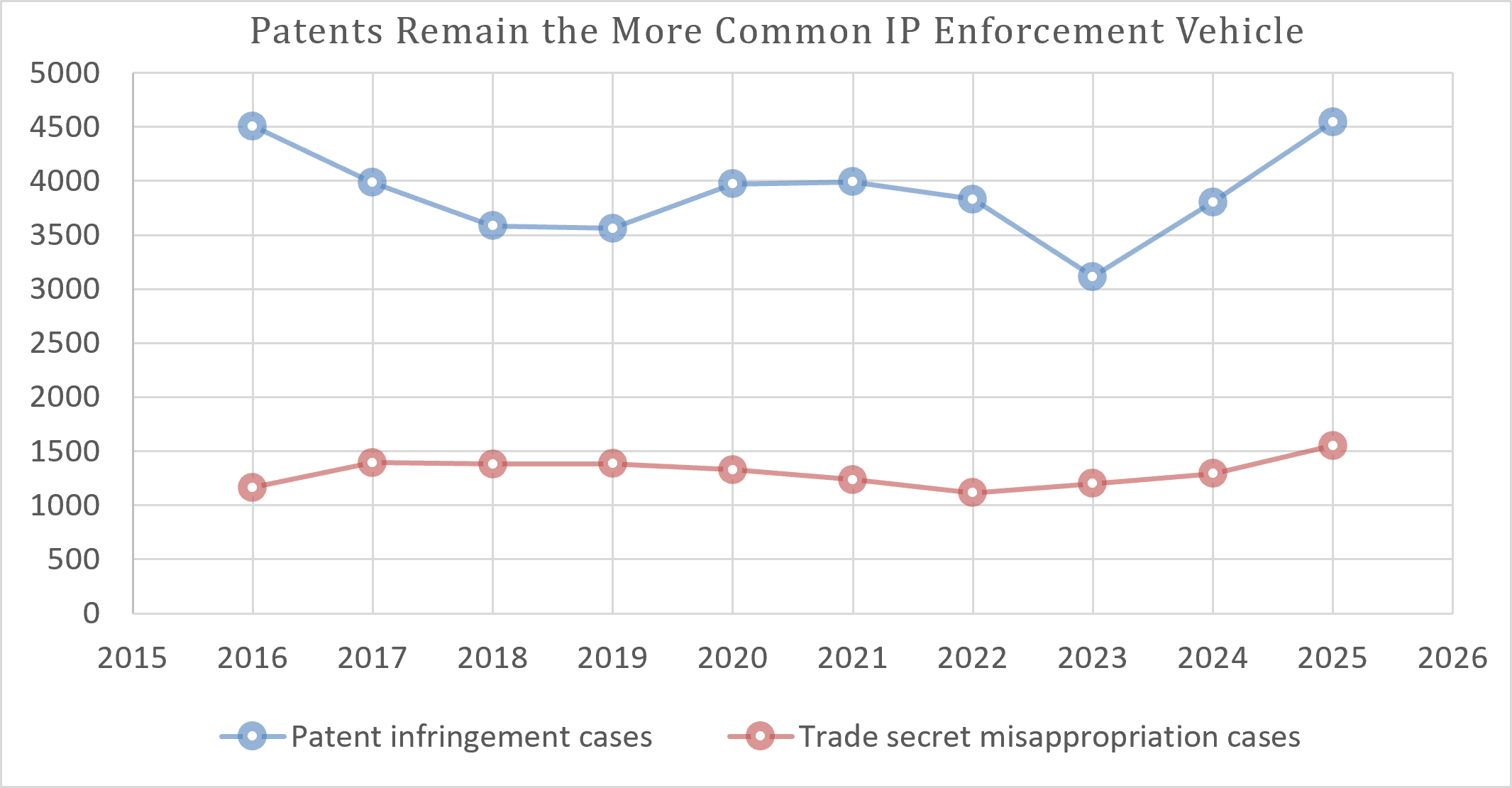
Sources: Lex Machina® “Patent Litigation Report 2026,” August 2026; Charles River Associates® “Trade Secret Litigation Watch,” February 2026 (internally citing Lex Machina®)
When Patent Protection Usually Makes Sense
Commercialization is often the dividing line between patent and trade secret protection. If a competitor can buy the product, disassemble it, measure it, test it and understand the inventive feature at commercially reasonable cost, trade secret protection may offer little practical protection. This is often true for mechanical devices, engineered components, medical devices, consumer products, distributed firmware, and technologies whose structure or operation can be learned from inspection or use.
Patent protection is also attractive when the invention has significant commercial or strategic upside. Drug candidates, biologics, platform technologies, diagnostics, high-value medical devices and core technical architectures may justify patent investment because the commercial reward can dwarf prosecution cost. Patents may also support financing, licensing, partnering, investor diligence and acquisition value.
Patents also help when the business model requires broad disclosure. If the invention must be shared with manufacturers, suppliers, CROs, CDMOs, strategic partners, distributors, investors or potential acquirers, the disclosure surface expands. Contracts still matter, but each additional recipient increases leakage risk and potential disputes over what was disclosed and under what restrictions. A patent application can convert some of that risk into an exclusionary right.
Finally, patents are often better suited to competitor disputes. In a patent case, the core question is generally whether the accused product, method, system or process meets the asserted claims. The patent owner generally does not need to prove copying. Independent development is not a defense to infringement.
When Trade Secret Protection Is the Better Fit
Trade secret protection tends to make sense when the innovation can be used commercially without being revealed.
Classic examples include formulas, recipes, process parameters, manufacturing know-how, quality-control methods, backend source code, internal algorithms, training data, model weights, customer analytics, pricing models and negative know-how. In many of these cases, the commercial product may reveal little about the underlying information.
Trade secret protection may also be preferable when patentability is uncertain. Some business methods, data-processing methods, diagnostic correlations, natural-product-related discoveries and software-implemented concepts may face significant eligibility, novelty, obviousness, written-description, enablement or enforceability challenges. If the invention can be kept secret, filing a patent application that publishes and then fails may create the worst of both worlds: no reliable patent protection, but public disclosure to competitors.
Trade secret enforcement also tends to arise from a different fact pattern than patent enforcement. Trade secret cases often involve broken relationships: former employees, founders, consultants, manufacturers, suppliers, investors, joint-development partners, licensees, distributors or potential acquirers.
That means contracts and internal controls matter. NDAs, invention-assignment agreements, employment agreements, consulting agreements, joint-development agreements, data-room terms, supply agreements and manufacturing agreements may provide the factual architecture for a trade secret claim. But they are not enough by themselves. A company should also be able to show what the trade secret is, who had access, why access was necessary, what confidentiality obligations applied, how information was marked or segregated, what technical controls were used and what happened when employees or partners departed.
A Practical Decision Matrix for Patent vs. Trade Secret Decisions
Technology or business context | Likely strategy | Strategic rationale | Concrete examples |
|---|---|---|---|
High-value inventions central to financing, licensing or market position | Patent | High value and likely independent development can justify patent cost. | Drug candidates; biologics; platform therapeutics; medical devices. |
Products with visible, testable or reverse-engineerable features | Patent | Secrecy is fragile if competitors can learn the invention at reasonable cost. | Mechanical devices; engineered components; consumer products; distributed firmware. |
Technologies likely to be disclosed through regulation, customers or commercialization | Patent | If disclosure is inevitable, secrecy is unlikely to last. | FDA-disclosed devices; diagnostic platforms; standards technology; customer-facing SaaS features. |
Inventions requiring broad external collaboration | Patent or patent-first | More recipients means more leakage risk, even with contracts. | CRO/CDMO programs; contract manufacturing; joint development; supplier-dependent processes. |
Hidden processes, parameters and production know-how | Trade secret | If the product does not reveal the process, secrecy may be more valuable than disclosure. | Process conditions; catalyst parameters; calibration protocols; yield-optimization methods. |
Confidential data, model and internal software assets | Trade secret | These assets may be inaccessible, hard to recreate and continuously improved. | AI model weights; training datasets; backend source code; pricing algorithms. |
Negative know-how and failed paths | Trade secret | Failed work can save competitors substantial time and expense. | Failed formulations; abandoned leads; nonviable architectures; rejected process windows. |
Subject matter with eligibility, patentability or enforceability risk | Trade secret or patent-first | Publication without reliable claims can educate competitors without creating exclusivity. | Food recipes; diagnostic correlations; business methods; data-processing concepts. |
Inventions difficult to police through patent litigation | Trade secret or patent-first | A patent may have limited value if infringement cannot realistically be detected. | Hidden manufacturing steps; server-side ranking; fraud detection; backend optimization. |
Enforcement expected against market competitors | Patent | Patent infringement turns on claim coverage, not copying. | Competing devices; generic drugs; copycat products; competing software functionality. |
Enforcement expected against employees, vendors, partners or diligence recipients | Trade secret | Trade secret cases often turn on access, duties, secrecy measures and misuse. | Departing employee with source code; manufacturer using drawings; investor misusing diligence materials; consultant retaining files. |
Short-life-cycle features or high design-around risk | Case-specific | Patent value may be limited if the market window is short or claims are narrow. | Seasonal features; fast-changing software; narrow device improvements; UI changes. |
How a Nonpublication Request Can Preserve Optionality
For some inventions, the best strategy is not choosing immediately between patent protection and trade secret protection. A company can file a U.S. nonprovisional patent application with a nonpublication request, prosecute the application confidentially, and evaluate patentability, claim scope, commercial relevance and cost-benefit economics before the application publishes.
If meaningful claims appear obtainable, the applicant can continue toward allowance. If prosecution reveals blocking prior art, persistent eligibility problems, commercially unhelpful claim scope or poor cost-benefit economics, the applicant may allow the application to abandon before publication or issuance, preserving trade secret protection if secrecy has otherwise been maintained.
This can be especially useful for software, data-driven inventions, internal processes, manufacturing methods and other innovations where patentability is uncertain but trade secret value may be significant.
There are important caveats. A nonpublication request is generally inconsistent with ordinary foreign filing plans unless the request is properly rescinded or the USPTO is timely notified of later foreign or international filing. And if the application issues, the disclosure becomes public. The strategy therefore requires a deliberate decision point before allowance: is the claim scope worth the disclosure?
The Best IP Strategy Is Usually Layered
Companies often benefit from using patents and trade secrets together. A company may patent the externally visible invention while keeping manufacturing know-how, model weights, training data, process parameters, failure data and other implementation details as trade secrets. The point is not to choose one form of protection for the entire business. It is to decide, asset by asset, which information should be disclosed for exclusionary rights and which information should remain controlled as confidential know-how. The strategic question is which form of protection best matches the technology, business model, disclosure environment, enforcement posture and budget reality.
For help evaluating whether a particular innovation is better suited for patent protection, trade secret protection or a layered IP strategy, contact Jacek Wnuk or your Polsinelli attorney.